Distributed VQLS · Chapter 03
What the numerical studies establish
Three studies separate representation capacity, the cost of finer partitions, and optimizer design. All are classical simulations of quantum algorithms, averaged over ten random initializations—not hardware experiments.
A structured 51-qubit instance
The large-instance experiment uses an Ising-inspired matrix with a compact Pauli representation. Four agents each represent 50 system qubits. Low-entanglement structure permits classical matrix-product-state simulation; overlaps are evaluated directly from that representation rather than by simulating every Hadamard-test circuit.
The large-scale test system
and are Pauli operators on qubit ; is the Hadamard gate. is a positive normalization constant and a spectral shift. The global matrix is . The setup is structured and classically simulable, not an arbitrary dense matrix at this scale.
Manuscript · Large-Scale Demonstration
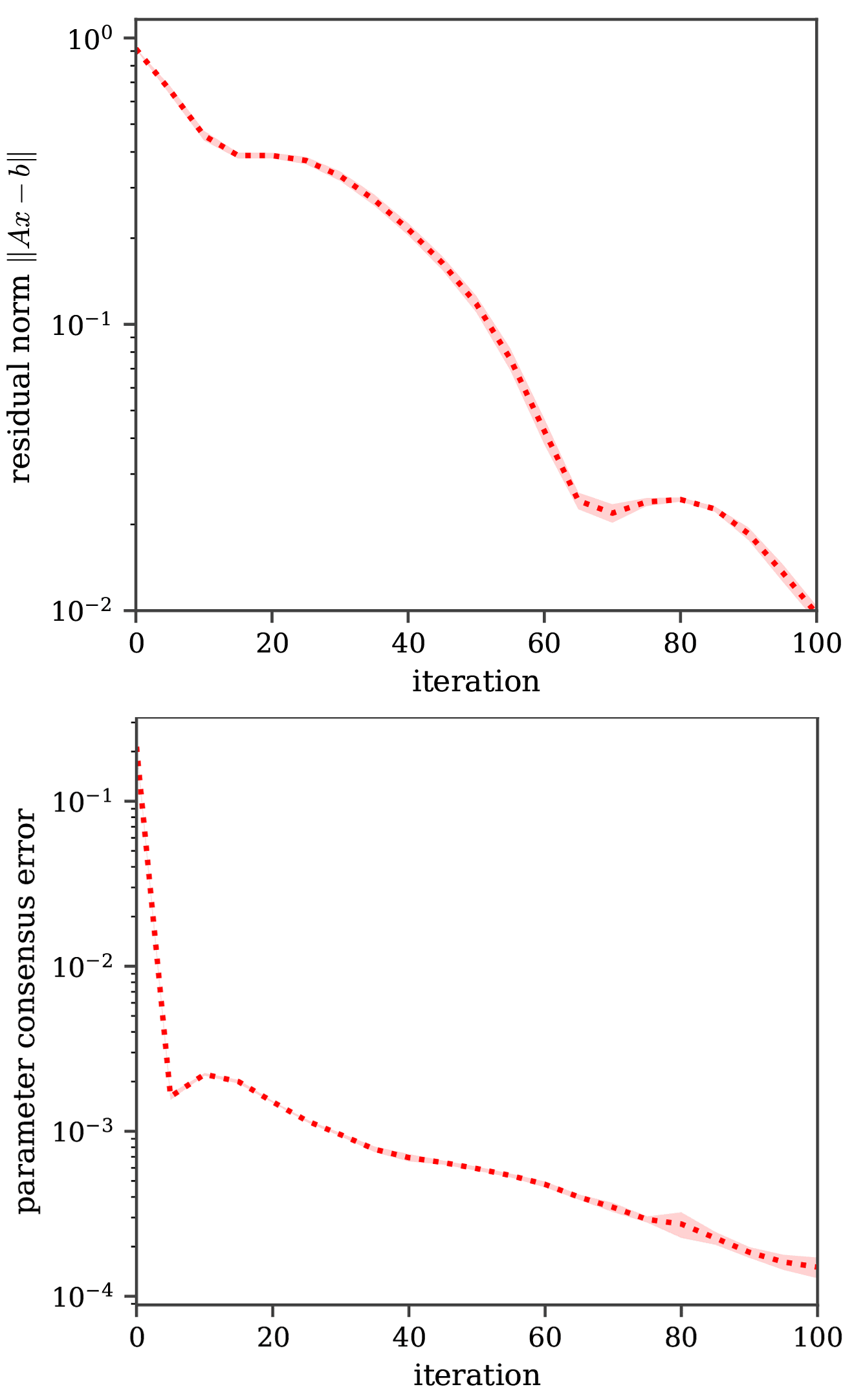
| Quantity | Reported value or observation |
|---|---|
| Block partition / agents | 2 × 2 / 4 |
| Global / local system qubits | 51 / 50 |
| Base stepsize / initializations | 0.02 / 10 |
| Global residual norm | Nearly two orders of magnitude lower over 100 iterations |
| Parameter consensus error | Decreases to approximately 10⁻⁴ |
Finer partitions reduce local size and slow optimization
A separate 13-qubit perturbed cluster-state system has condition number 20 and six Pauli terms. This smaller experiment explicitly simulates Hadamard-test circuits. Both communication graphs are paths, and the base stepsize is 0.01.
Residual and state-vector agreement are different metrics
is the scaled local state, so stacks all estimates in block row . measures equation error; measures agreement between those row estimates. In this study agreement is reached sooner than a small residual. Unlike the 51-qubit study, is defined in vector space, not parameter space.
Manuscript · Effect of Block Partitioning
| Partition | Agents | Local system qubits | Reported behavior |
|---|---|---|---|
| 1 × 1 | 1 | 13 | Fastest residual reduction; centralized version of this objective |
| 2 × 2 | 4 | 12 | Slower reduction than the centralized case |
| 4 × 4 | 16 | 11 | Residual eventually fluctuates around 10⁻² |
| 8 × 8 | 64 | 10 | Slowest case; residual eventually around 10⁻² |
The classical optimizer materially changes the outcome
The ablation uses a 7-qubit Ising-inspired system, a 4 × 4 partition (16 agents, five local system qubits), condition number 200, and base stepsize 0.01. It changes one component at a time while keeping the test problem fixed.
| Variant | Change from the full method | Reported observation |
|---|---|---|
| Track + AdamX + AdamZ | None | More than 100× reduction by approximately 10,000 iterations |
| Track + AdamZ | Gradient descent replaces Adam for x parameters | Residual remains above 1 at 20,000 iterations |
| Track + AdamX | Gradient descent replaces Adam for z parameters | Residual remains above 1 at 20,000 iterations |
| Consensus + AdamX + AdamZ | Remove gradient tracking | Residual remains above 1 at 20,000 iterations |
Which costs determine practical usefulness?
The reformulation is exact, but the experiments do not establish a quantum advantage or a general convergence guarantee. The next stage should measure the resources and reliability of the complete hybrid algorithm.
- Conditioning and connectivity: vary the matrix condition number, agent count, and row/column graphs independently.
- Communication: reduce the present two transmission rounds; account for latency, delays, and asynchronous updates.
- Hardware: measure circuit, sampling, and readout costs under realistic noise before claiming improved resilience or speed.
Last updated